Large-Format Indoor LED Screens for Luxury Home Theaters & Media Rooms
How large-format indoor LED wall screens replace projectors in luxury home theaters, media rooms, and golf simulator spaces with seamless, bezel-free 115" to 317" cinema-scale viewing.
In This Guide
- 01.Why Indoor LED Walls Are Replacing Projectors
- 02.Bezel-Free Cinema Scale in Any Room
- 03.Golf Simulators, Media Rooms, and Multi-Use Spaces
- 04.Brightness and Contrast Without a Dark Room
- 05.Modular, Repairable, and Built to Last
- 06.Integrating with Sound, Lighting, and Home Automation
- 07.How to Choose the Right Indoor LED Size
- 08.What an Indoor LED Wall Installation Involves
- 09.Frequently Asked Questions
A dedicated home theater used to mean one thing: a dark, light-controlled room with a projector pointed at a screen. That model still works, but it limits how and when you use the space. The moment someone turns on a lamp or opens the shades, the picture washes out. The bulb dims over time. The contrast that looked dramatic on day one softens after a few years of use.
Large-format indoor LED screens change the math. Instead of projecting light onto a surface, the wall itself emits the image, bright, even, and vivid in any room lighting. The result is a true cinema-scale picture that holds up in a sun-filled media room, a lounge with the lights on, or a basement that doubles as a golf simulator bay.
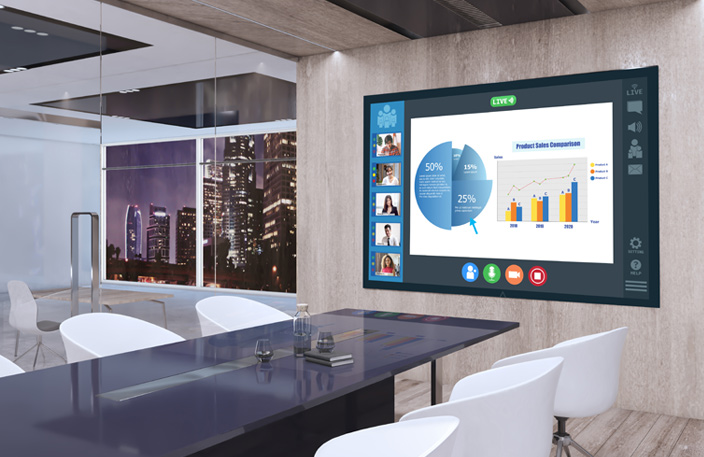
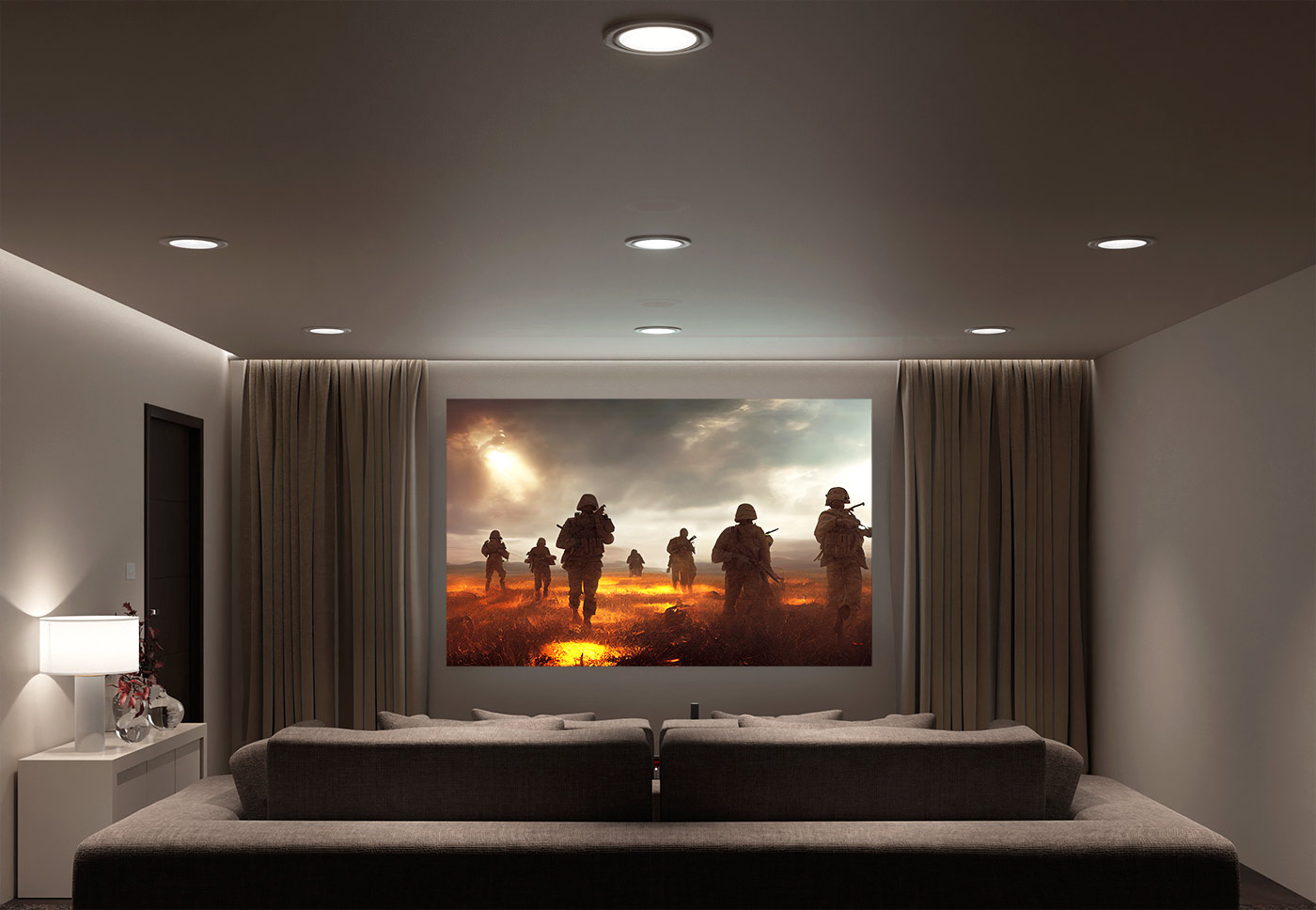
A seamless indoor LED wall turns a media room into a cinema-scale viewing space without projector shadows or dark-room requirements.
Why Indoor LED Walls Are Replacing Projectors
The comparison comes down to how each technology produces an image. A projector bounces light off a screen, so anything that lights the room, windows, lamps, recessed cans, competes with that image. An LED wall is the light source. The pixels emit their own brightness, so ambient light does not wash the picture out.
That single difference unlocks how you use the room.
| Factor | Traditional Projector | Large-Format Indoor LED Wall |
|---|---|---|
| Room lighting | Needs a dark, light-controlled room | Vivid in fully lit or daylight rooms |
| Image source | Reflected light off a screen surface | Self-emitting pixels (the wall is the image) |
| Contrast over time | Bulb fades; contrast softens with age | Stable brightness and color for years |
| Maintenance | Lamp/bulb replacement cycles | Modular; service individual components |
| Screen seams | One surface, but limited by screen size | Seamless from 115" to 317" with no panel borders |
| Viewing in a lit room | Washed out the moment lights go up | Holds contrast with the lights on |
If your media room is also a living space, a place to watch a game with friends, host a movie night, or let the kids play in the same room, an LED wall lets you keep the lights on without sacrificing the picture.
Bezel-Free Cinema Scale in Any Room
A standard 85-inch TV reads large in a living room but small in a dedicated media room with tiered seating. Projectors can throw a bigger image, but the picture quality depends on throw distance, screen material, and how dark you can make the room.
Indoor LED walls sidestep both limits. Seamless configurations run from 115" to 317" with no visible panel borders, so the image is one uninterrupted surface, no bezel lines cutting across a football field or a movie's establishing shot. The wall scales to the room rather than forcing the room to work around the screen.
For a private home theater, that means a true cinema-scale canvas on the wall where a 120" pull-down screen used to live. For a media room, it means a screen large enough to read from every seat without a projector box mounted on the ceiling.
Pro Tip: Size the wall to your furthest seating distance, not the closest. In a media room with a bar in the back, the people at the bar need a readable picture too. A larger seamless wall keeps the image crisp for the whole room instead of just the front row.
Golf Simulators, Media Rooms, and Multi-Use Spaces
An indoor LED wall is not only for movies. The same display that runs a feature film on Friday night can drive a golf simulator on Saturday morning or a watch party on Sunday.
Because the wall is bright and seamless, it works as a high-impact backdrop for any activity where a large, sharp image matters, golf and sports simulators, gaming setups, live sports, or even a rotating art display when the room is not in use. You are not locked into "theater mode or nothing."
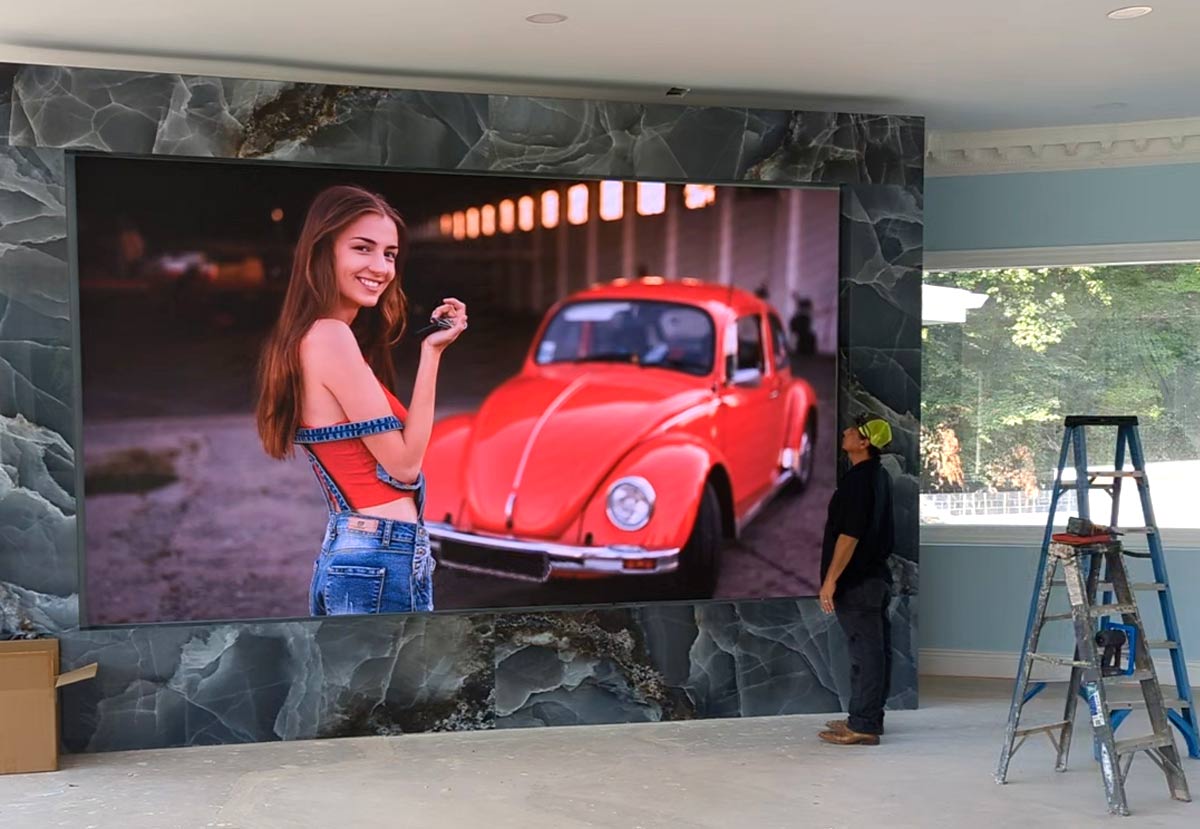
Watch a large-format indoor LED wall in action, cinema-scale viewing that holds up with the lights on.
For a golf simulator bay, the advantage is consistency. A projected simulator image shifts if the launch monitor or screen alignment drifts, and the picture dims in a room that is not fully darkened. An LED wall keeps the same brightness and color regardless of room lighting, so the simulator readout stays legible and the course render stays vivid.
Brightness and Contrast Without a Dark Room
The biggest day-to-day difference owners notice is simple: you can actually use the room. A projector-based theater is a room you enter, darken, and use for one purpose. A media room with an LED wall is a room you live in.
You can watch an afternoon game with the shades up. You can host a movie night without making everyone stumble to their seats in the dark. The picture stays high-contrast because the wall emits its own light rather than fighting the room's light.
That also changes how the room is designed. You do not need blackout curtains, dark wall finishes, or a ceiling boxed in to hold a projector and its cabling. The display mounts flush to the wall, and the rest of the room can be finished like a normal, comfortable living space.
Modular, Repairable, and Built to Last
A projector's bulb is a wear item. When it dims, you replace it; when the projector ages out, you replace the whole unit. A large-format LED wall is built differently. The display is modular, individual LED components can be serviced independently, so a single module does not force a full-display replacement.
That is the same serviceability philosophy YOLO TV applies across its display systems. Indoor residential displays carry the same industry-leading 5-Year Peace of Mind Parts Warranty, and because the LED systems are modular, many parts can be replaced individually without replacing the entire display. On-site service, technician travel, shipping, and third-party labor may be separate unless specifically included in your agreement.
Every YOLO TV residential display is backed by our industry-leading 5-Year Peace of Mind Parts Warranty. Covered YOLO TV components are protected for five years, and because our LED systems are modular, many parts can be replaced individually without replacing the entire display. On-site service, technician travel, shipping, and third-party labor may be separate unless specifically included in your agreement.
Why modularity matters indoors
In a permanent wall installation, you do not want a single component failure to mean tearing out the whole display. Modular construction means a technician can address the affected part and leave the rest of the wall intact, the same way a screen section is serviced, not the entire theater rebuilt.
Integrating with Sound, Lighting, and Home Automation
An indoor LED wall is a display, not an all-in-one TV. That is an advantage, not a limitation. It means the screen plays whatever you connect to it, a streaming device, an AV receiver, a golf simulator PC, or a whole-home automation system, and your audio is designed as its own system rather than relying on built-in speakers.
For a media room, that lets you pair the wall with a dedicated surround or immersive audio setup sized to the room. For a golf simulator bay, the same wall can run the simulator while your sound system handles the impact and course audio. Because the display accepts standard source inputs, it drops into an existing AV or home automation setup as another zone rather than a standalone box.
If you already run a control system, the wall becomes part of that ecosystem, one that can be upgraded by swapping a source rather than replacing the screen.
How to Choose the Right Indoor LED Size
The right size depends on how you use the room and where people sit.
- Dedicated home theater: Match the wall to your furthest row. A cinema-scale wall reads comfortably from across tiered seating, where a smaller TV would feel distant.
- Media room with mixed seating: Size for the back of the room. If the bar or lounge is 18–24 feet from the wall, a larger seamless display keeps the picture legible for everyone, not just the front row.
- Golf simulator bay: Follow the simulator's recommended impact-zone width. The wall needs to cover the play area and the readout without the image breaking up at the edges.
- Living space that doubles as a media room: Choose a size that looks intentional in the room when the display is off, not just when it is on.
An indoor LED wall keeps a vivid, high-contrast picture even in an open, daylight-filled living space.
What an Indoor LED Wall Installation Involves
A flush wall installation is cleaner than a projector setup, but it still needs to be planned before the room is finished. The wall needs a structurally sound mounting surface, planned power and signal runs, and a signal path from your sources to the display. Getting these details sorted during a build or remodel, before the drywall and finishes go up, is far less invasive than retrofitting later.
If you are already renovating a media room, basement, or dedicated theater, that is the ideal time to design the wall in. The structural backing, electrical, and cabling can be planned alongside the room's framing, the same way you would plan any other built-in feature.
Key Takeaway: A large-format indoor LED wall replaces the compromises of a projector, dark rooms, fading bulbs, washed-out contrast, with a seamless, cinema-scale display that holds its picture in a fully lit room. Plan the wall, power, and signal path during the build, and the room becomes a permanent, multi-use entertainment space rather than a single-purpose dark room.
Frequently Asked Questions
Quick answers to the questions homeowners ask most.
A projector reflects light off a screen, so it needs a dark room and fades as the bulb ages. An indoor LED wall emits its own image, so it stays bright and high-contrast in a fully lit room with no bulb replacements. The wall is also seamless from 115" to 317", with no panel borders.
Yes. That is one of the main reasons owners choose an LED wall over a projector. Because the pixels emit their own light, ambient room lighting does not wash the picture out, so you can watch with the lights on or shades up.
Yes. A seamless, high-brightness wall keeps the simulator image and readout sharp and legible regardless of room lighting, where a projected image can dim or shift if the room is not fully darkened or the alignment drifts.
Indoor configurations run seamlessly from 115" to 317" with no visible panel borders. The right size depends on your furthest seating distance and how the room is used, a dedicated theater, a media room with mixed seating, or a golf simulator bay each call for a different scale.
The display is modular, so individual LED components can be serviced independently rather than replacing the entire wall. YOLO TV indoor residential displays are backed by a 5-Year Peace of Mind Parts Warranty; on-site service, technician travel, shipping, and third-party labor may be separate unless specifically included in your agreement.
Written by Brian Bachman
YOLO TV designs and installs luxury outdoor TVs, hidden Rise™ TV systems, and custom outdoor entertainment solutions for homeowners, builders, architects, designers, and AV integrators. Our engineering team specializes in creating unforgettable outdoor viewing experiences.
Standard Specifications
- Display Tech
- Direct-View Seamless LED
- Screen Sizes
- 115" to 317"
- Bezel Width
- 0mm (Seamless)
- Warranty
- 5-Year Parts Coverage
Find the Right Display for Your Outdoor Space
Send YOLO TV a few pictures of your backyard, your installation address, and your approximate viewing distance. We'll help determine the size, brightness, and configuration that make sense for your space.
You May Also Like
More guides and case studies from the YOLO TV engineering team.