You can put a big screen on a patio and call it outdoor entertainment. That's how most projects start, and it's usually where the trouble starts too. A luxury backyard with real seating, real sun exposure, and real weather does not behave like a family room with a grill nearby. The screen has to survive the environment, stay readable in daylight, and fit the architecture instead of fighting it.
A proper large outdoor TV is not a consumer television with a weather story attached. It's an installed display system, which means the size, brightness, mounting, power, structure, and control layer all have to work together. If those pieces are treated like afterthoughts, the result is predictable, washed-out images, awkward sight lines, overloaded circuits, and a screen that looks temporary even when the house isn't.
Table of Contents
- Why a Large Outdoor TV Is Not Just a Bigger Television
- Brightness, Pixel Pitch, and Viewing Distance
- Weatherproofing and Climate Durability
- Fixed Mount or Rise On-The-Go Mobile
- Power, Structural, and Control-System Integration
- Sizing for Group Viewing, Not Just Distance
- Site Planning Checklist for Architects and Builders
- Long-Term Value and Choosing the Right Partner
Why a Large Outdoor TV Is Not Just a Bigger Television
A homeowner sees a 75-inch screen and assumes the job is finished. A consultant sees glare, off-axis seating, wind exposure, and a wall that may never have been built to carry a display this large. That is why so many outdoor TV projects disappoint by the first major event.
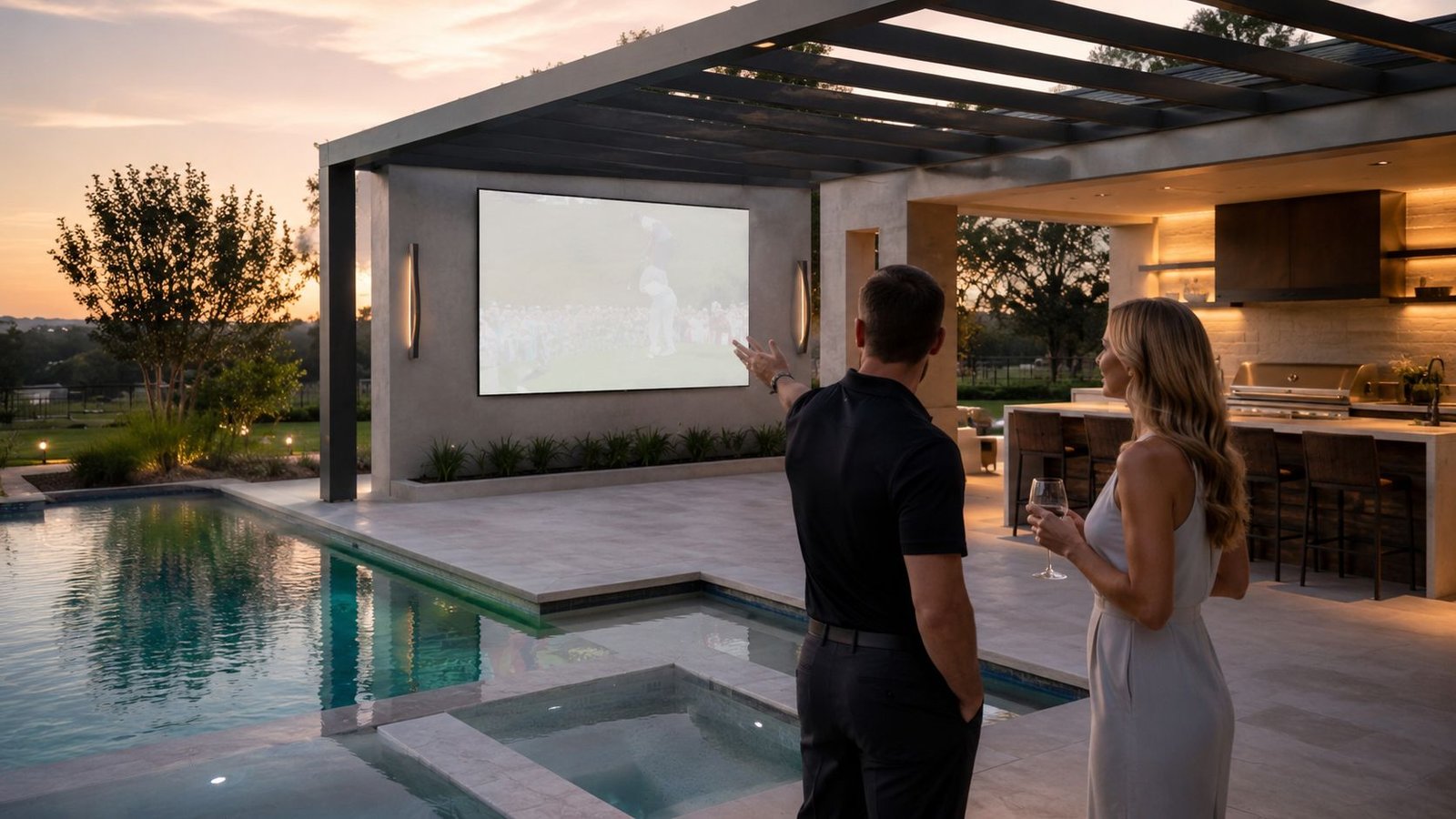
The category is infrastructure, not furniture
The global outdoor TV market was estimated at USD 443.4 million in 2024 and is projected to reach USD 753.8 million by 2030, which implies a 9.5% CAGR from 2025 to 2030 (Grand View Research). That growth matters, but the key takeaway is what buyers are choosing. In 2023, residential applications accounted for 55.3% of revenue, and the 55-inch to 70-inch category represented 39.0% of revenue in that same market (Grand View Research). Large-format outdoor viewing is already the default residential use case.
That is exactly why a casual patio TV mindset fails. A screen in this category has to stand up to sunlight, fit the architecture, and keep working for years without turning into a maintenance headache. Treat it as equipment that belongs in the wall, not a screen that happens to sit near the pool.
Scale changes the entire project
One of the largest outdoor residential installs YOLO TV has completed was a 287-inch ultra-wide outdoor LED screen in a private backyard and patio setting. It measured about 6 feet 6 inches tall by 23 feet wide, which changes the experience completely. It no longer behaves like a television in the usual sense, it works more like a private stadium screen or a luxury outdoor entertainment wall.
That scale exposes the planning mistake most buyers make. A consumer TV can be chosen from a catalog. A permanent outdoor display needs the same discipline you would apply to a pool house, an outdoor kitchen, or a retaining wall. If the site is in Arizona, the whole outdoor room matters, not just the screen, and a useful reference is an analysis of easy-care outdoor designs for Arizona from Pool & Landscaping of Vistancia LLC. The display should fit that kind of design thinking.
For a closer look at the architectural approach, see YOLO TV breaks the boundaries of ordinary outdoor TVs. That is the right frame for this category.
Practical rule: If the screen requires a separate conversation about structure, power, climate, and sight lines, it is not a television purchase. It is a project decision.
Brightness, Pixel Pitch, and Viewing Distance
Three numbers decide whether a large outdoor display looks right. Brightness determines whether the image survives daylight. Pixel pitch determines how sharp it looks at the seating distance. Field of view determines whether the image feels comfortable for a group.
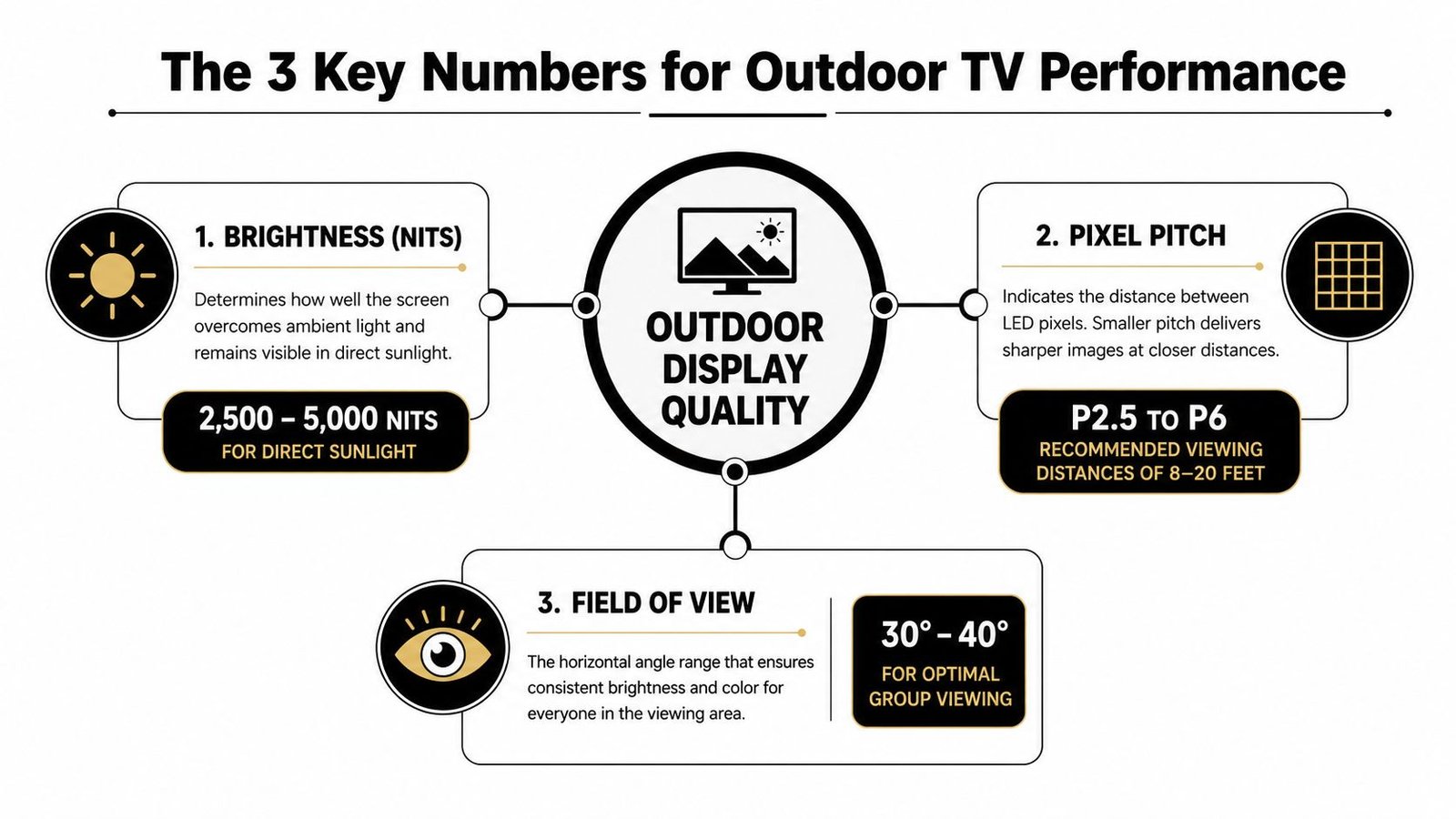
Brightness is not optional in daylight
Outdoor TV buying guides consistently separate shaded and full-sun use cases. Consumer-facing sources commonly put shaded outdoor viewing around 700 nits and full-sun viewing at 2,500+ nits, with one roundup flagging 2,000 nits as the minimum for clear direct-sun viewing (Spencer's TV). For a real full-sun install, YOLO TV's design guidance lands closer to 6,000 nits, with contrast around 5000:1 for outdoor LED systems.
That's the right mindset. Brightness has to overpower the environment, but brightness alone is a weak specification if the image still looks flat. The display must keep color separation and depth, especially when the patio finishes, stonework, and water surfaces reflect light back into the viewing zone.
Pixel pitch decides how close people can sit
Pixel pitch is the next filter, and most buyers skip it. They shouldn't. Fine-pitch displays, including 1.6–1.9 mm pixel pitch, preserve clarity at shorter distances and are common in high-end outdoor MicroLED systems that can also reach 4,000 nits, 3,840 Hz refresh, 7,000:1 contrast, and a 100,000-hour rated lifespan while operating from -20°C to +45°C (C SEED). That's a very different class of product from a consumer outdoor set.
The tradeoff is straightforward. Finer pitch means better close-up image quality, but it also brings higher power, weight, and heat management demands. If the seating is close, do not save money by using a coarse panel and hoping nobody notices. They will.
Design rule: Choose brightness for the sun, pitch for the seats, and size for the room. If one of those is wrong, the whole install feels wrong.
Use distance as a starting point, not the answer
A narrow patio with a centered sofa and a wide entertaining zone do not need the same screen. That's why internal planning matters so much. A designer should use the 30° to 40° field of view idea as a comfort target, then look at how the patio gets used instead of relying on one person's eye-line. For a practical sizing framework, see how to choose the right pixel pitch for your outdoor TV.
For the right project, the result is simple. The image stays legible at noon, crisp at night, and balanced across the main gathering area.
Weatherproofing and Climate Durability
Outdoor gear is often sold with one word, weatherproof, and that word hides a lot. A display can resist rain and still struggle with humidity, UV exposure, heat soak, or freeze-thaw movement over time. Climate is not a footnote, it is part of the specification.
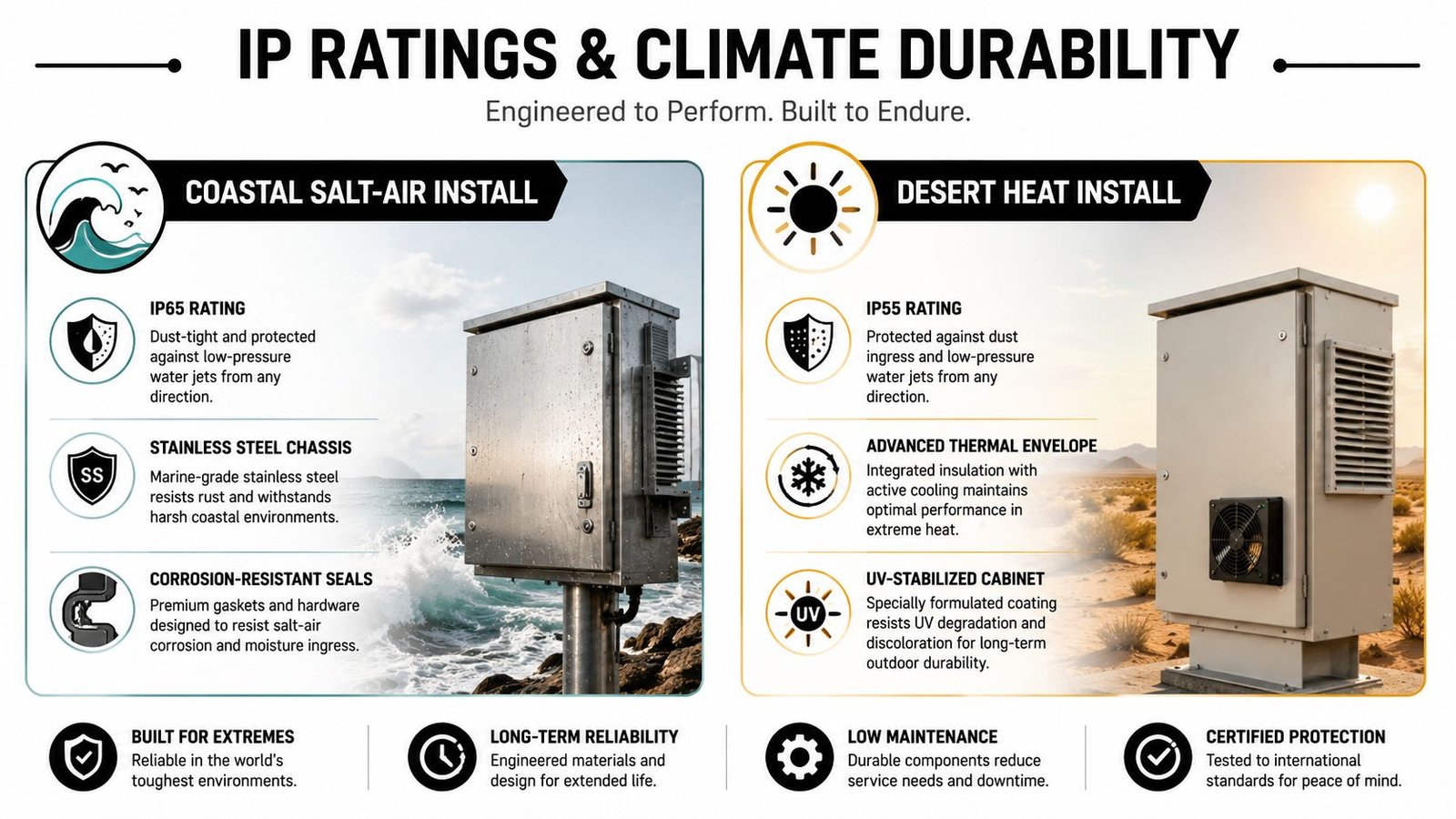
IP ratings are only part of the story
Many guides talk about moving from IP54 to IP65 or higher in harsher environments, and the logic is sound (Furrion). An IP65 threshold helps against dust and water ingress, which matters in coastal wind, desert grit, and exposed patios. It does not solve UV breakdown, corrosive salt air, or long-term thermal stress by itself.
That distinction is where cheap outdoor sets fall apart. The box may be sealed well enough for rain, but the cabinet, fasteners, thermal path, and internal electronics still have to live outside. A display in Miami has different pain points from one in Scottsdale or Boston, and the spec should change accordingly.
Match the cabinet to the climate
Coastal installations need corrosion resistance first. Salt spray gets into everything, and once it starts attacking hardware, service intervals get shorter and failures get uglier. Desert installs need thermal discipline, because the cabinet has to survive hard afternoon heat without cooking the electronics. Freeze-thaw markets need stability across temperature cycling, because expansion and contraction expose weak seals and sloppy mounting.
A clean way to consider it:
- Coastal sites: Prioritize corrosion-resistant hardware, sealed seams, and maintenance access.
- Desert sites: Prioritize thermal management, UV-stable materials, and shade-aware placement.
- Freeze-thaw regions: Prioritize cabinet integrity, moisture control, and tolerance for repeated cycling.
- Subtropical sites: Prioritize humidity resistance and drainage around the structure.
For a deeper product-level explanation of protection thresholds, review what an IP66 rating means in outdoor TVs. The rating matters, but the climate matters more.
Don't confuse resistance with permanence
Outdoor installations need protection against rain, humidity, sun, dust, and temperature exposure, and buyers usually want the screen to stay in place year-round. That marks a key shift. Seasonal patio gear is not the same thing as a permanent architectural display, because permanent systems have to survive the calendar, not just the weather forecast.
Fixed Mount or Rise On-The-Go Mobile
The first question is not which model is prettier. It's whether the screen should behave like part of the architecture or like a movable asset. That choice changes everything from wiring to storage to how often the display is visible.
Permanent wall mount suits a real entertainment room outdoors
A fixed display works best when the space already has a clear center of gravity. Covered patios, pool houses, rooftop terraces, courtyards, and outdoor kitchens all support a wall-mounted screen when the seating, shade, and power are already planned. It gives the space a finished look and removes the friction of moving equipment in and out for every event.
This is the right answer for homeowners who know the display will live there. If the screen is part of the view from the fire table, the bar, or the lounge, then hiding it every time becomes a nuisance. In those cases, fixed is cleaner and more practical.
Mobile deployment is a flexibility play
The Rise On-The-Go™ mobile option makes sense when the property needs flexibility. It can be rolled into position for events and stored when not in use, which is useful for seasonal entertaining, changing layouts, or properties where there isn't a natural wall for a permanent mount. If the client wants the screen only when entertaining, mobility is a legitimate advantage.
A screen that disappears when you don't need it solves a different problem than a screen built into the wall. Use the one that matches the property, not the one that sounds exciting in a showroom.
The decision comes down to site behavior
Ask four questions and the answer usually shows up fast.
- Where do people sit? If there's one obvious gathering zone, fixed usually wins.
- Where will the screen live when it's not in use? If storage is awkward, mobility stops being elegant.
- How close is power? If the circuit path is messy, the design gets more expensive.
- How often do you want to see the screen? If the homeowner wants it as part of the architecture, mount it. If not, keep it mobile.
The right choice is not about product preference. It's about lifestyle and layout.
Power, Structural, and Control-System Integration
Large displays fail when they're treated like plug-in appliances. A serious outdoor screen needs power capacity, structural support, data planning, and service access before anyone starts hanging hardware.
The electrical load is real
Commercial outdoor systems in the 115" to 175" range are listed at roughly 300 to 1,150 lb and require 20 to 40 amps at 240V, with depth around 3.5 inches (Outdoor Living Way). That matters because the circuit, anchoring, and wall design must all support the chosen display class. If the service is underpowered, the system can limit peak brightness or shut down unnecessarily.
A clean outdoor power plan is also worth reviewing with the electrician early. For a practical reference point on weather-ready outdoor power placement, see outdoor power point installation in Brisbane from DLG Electrical. The lesson is universal, outdoor power has to be planned, not improvised.
The wall and the mount have to earn the screen
A screen that big cannot be treated like a standard television. The substrate must carry the weight, maintain a flat mounting plane, and hold against wind loading where applicable. That means you verify the wall build, the anchoring locations, the service clearances, and the route for future maintenance before the finish materials go up.
YOLO TV's spec documents, for example, typically include the display dimensions, approximate weight, mounting location, cabinet layout, mounting requirements, support locations, power requirements, data requirements, processor location considerations, service access, and site-specific notes. Any serious integrator should be able to hand the builder the same kind of package.
Data and control should be designed, not patched in
Outdoor screens still need a clean signal path. Depending on the run, fiber or Cat6 may be the better choice, but the final call belongs in the design phase, not after drywall or stone is finished. The processor location matters too, because heat, access, and cable management all affect serviceability.
Smart-home integration should sit on top of that foundation. Control4, Crestron, and Savant are the right layer if the homeowner wants the screen to behave like the rest of the estate, with lighting, shading, audio, and source control tied together.
| Large Outdoor TV Infrastructure Requirements at a Glance | |||
|---|---|---|---|
| Display Class | Approx. Weight | Electrical | Depth |
| 115" to 175" commercial outdoor systems | 300 to 1,150 lb | 20 to 40 amps at 240V | Around 3.5 inches |
Sizing for Group Viewing, Not Just Distance
Most buying guides still reduce sizing to a single measurement, sit here, measure that, buy the screen that matches the formula. That works for a den. It fails on a patio where guests are spread across a sectional, a dining zone, and a bar.
The patio is a viewing area, not a single seat
RTINGS ties comfortable TV sizing to a 30° to 40° field of view, while other guides still use rough distance-to-size rules. The problem is that a luxury outdoor space is rarely built around one centered viewer. It's built around a group, and the viewers on the ends of the seating run see the screen at an angle, not head-on (BBQGuys).
That off-axis issue matters. Many LCD and QLED outdoor displays lose color consistency for side seats, so the person at the end of the sofa gets a different image than the person in the middle. In a long patio layout, that's not a minor issue, it's the difference between a screen that serves the whole group and one that only looks right from the best chair.
Widen the thinking before you widen the screen
If the seating area is broad, the answer may be a much larger format, a more centered architectural placement, or a different panel strategy entirely. A wider ultra-wide display can make more sense than a traditional 16:9 setup in a space built for multiple viewers and multiple content sources. The goal is to cover the primary gathering zone, not the architectural width of the wall.
A useful way to judge the project:
- Center seat comfort: Does the screen fill the main viewing cone without strain?
- End-seat clarity: Do side viewers still get usable color and contrast?
- Content use: Will the screen show one game, multiple feeds, or mixed entertainment?
- Space geometry: Is the layout long, shallow, or wrapped around a pool?
If the space is designed for ten guests, the screen should serve ten guests, not one person in the middle.
Wider does not always mean better
A bigger panel helps only when the seating geometry supports it. If the display gets too large for the viewing distance, the image becomes overwhelming. If it's too small, the group at the far end loses immersion. The right answer comes from the primary gathering zone, not from the wall dimensions alone.
Site Planning Checklist for Architects and Builders
The expensive mistakes happen before the wall is built. Once stone, stucco, millwork, or waterproofing is finished, changing the screen location becomes a redesign problem instead of an install problem.
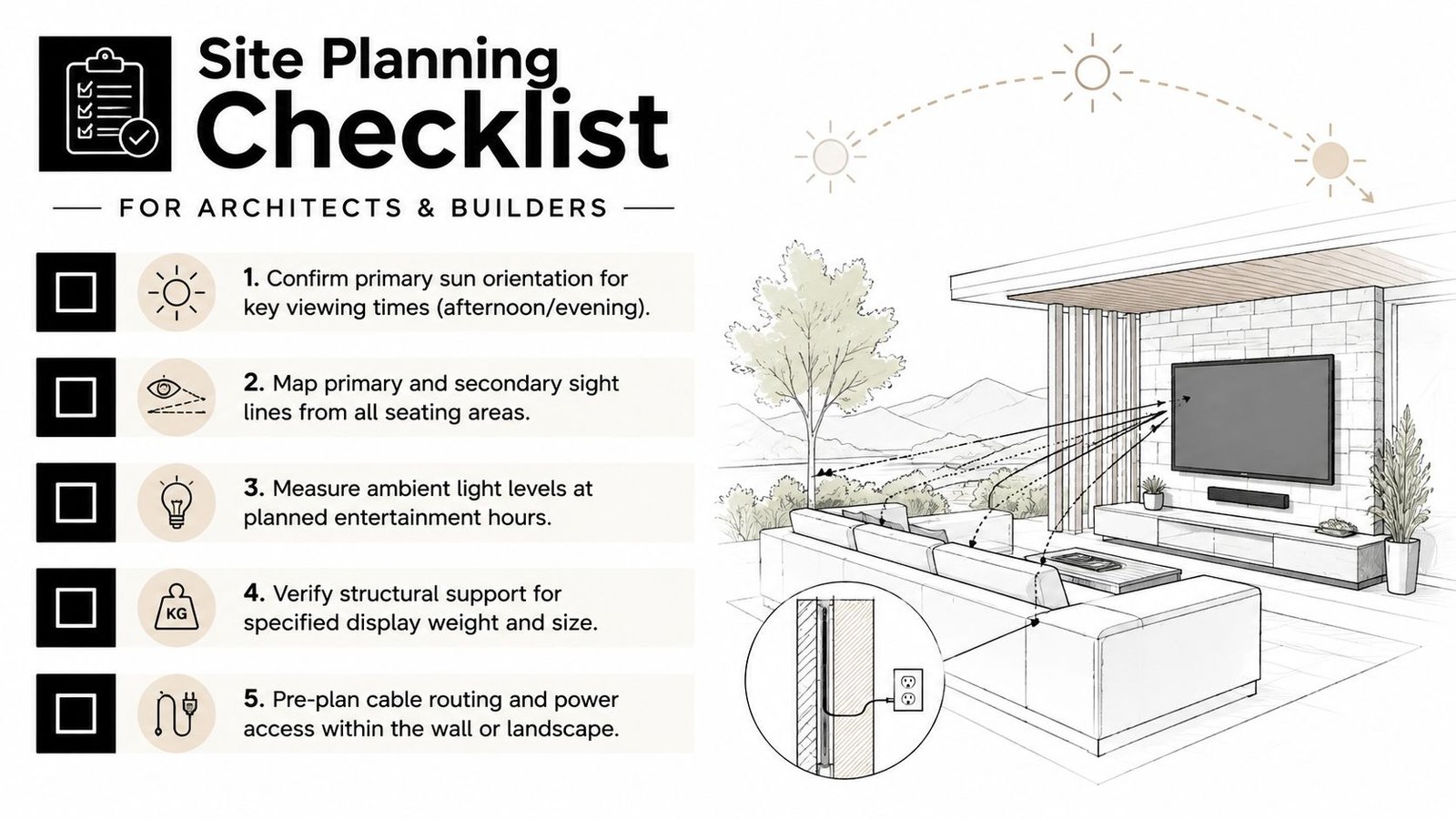
The checklist starts with the environment
The first pass should answer where the screen is going to be used, not just where it can physically fit. Sun orientation at the actual entertainment hours matters. So does ambient light, because a screen that looks fine at dusk may fail completely at 4 p.m. on a bright terrace. A project in Austin, for example, needs a different light strategy than one in a shaded coastal courtyard, and outdoor living space design for Austin is a good reminder that the whole site has to work together.
Builders need this information early
A serious pre-install checklist should include:
- Primary sun orientation: Confirm where the sun hits during afternoon and evening use.
- Sight lines: Map the main and secondary seating positions.
- Ambient light: Measure the space during the hours the homeowner will entertain.
- Structural support: Verify the wall or frame can carry the specified display weight and size.
- Cable routing: Pre-plan conduit, power, and data paths before finishes go in.
- Service access: Leave room for maintenance, future panel service, and equipment changes.
These are not optional details. They're the difference between a wall that accepts the display cleanly and a wall that needs expensive rework.
Serviceability protects the investment
The screen should be designed so a technician can reach it without tearing apart the architecture. That means access panels, clean cable runs, and a processor location that doesn't get buried behind permanent finishes. If the project is large enough to justify a custom display, it's large enough to justify future service planning.
The best outdoor TV install is the one the builder can finish once and the technician can service later without drama.
Long-Term Value and Choosing the Right Partner
A large outdoor display is a long-term architectural asset, not a disposable electronics buy. That's why warranty, lifespan, climate fit, and structural execution matter more than the sticker price.
Consumer outdoor sets tend to live in a very different world. A permanent display system built for luxury outdoor use is designed for much longer service life, including a 100,000-hour lifespan class in premium LED systems and a five-year residential warranty on YOLO TV systems. Cheaper gear usually fails in the worst possible ways, with washout during the biggest party of the year, corrosion in salt-air climates, or a wall that was never built to carry the load.
Pick the partner who asks for photos, site dimensions, sun orientation, and seating plans before talking about models. That's the consultant you want on a high-value project. If you're planning a backyard, pool deck, rooftop terrace, or hospitality space and want it done as an installed system instead of a retail purchase, send the space details and ask for a design review.
YOLO TV designs and installs permanent large-format outdoor display systems for luxury homes, estates, and high-end outdoor living spaces. If you're planning a project and want the screen sized, specified, and integrated correctly the first time, visit YOLO TV and request a design consultation with photos of your space.