Full Sun Outdoor TV Guide 2026: How to Choose a Bright, Weatherproof Display for Direct Daylight
A true full-sun outdoor TV needs 6,000+ nits, anti-glare engineering, active thermal management, and IP65–IP68 weather sealing. Learn how direct-view LED beats glare, heat, and reflections all afternoon.
In This Guide
- 01.What Defines a True Full Sun Outdoor TV?
- 02.Why Brightness Is the Starting Point
- 03.Orientation and Time of Day Matter
- 04.Thermal Management: The Hidden Spec
- 05.Weather Protection for Permanent Placement
- 06.Sizing a Full-Sun Display to the Space
- 07.Planning the Install Before the Pour
- 08.Frequently Asked Questions
There's nothing quite like watching your favorite team under an open blue sky or gathering family beside the pool for an outdoor movie. But if you've ever tried moving a conventional television outside, you already know the problem: the sun wins every time.
Washed-out contrast, blinding glass reflections, and thermal shutdown are why a true full sun outdoor TV exists. It is not an indoor panel in a box, it is a display engineered from the pixel up to stay readable in direct, unshaded daylight.

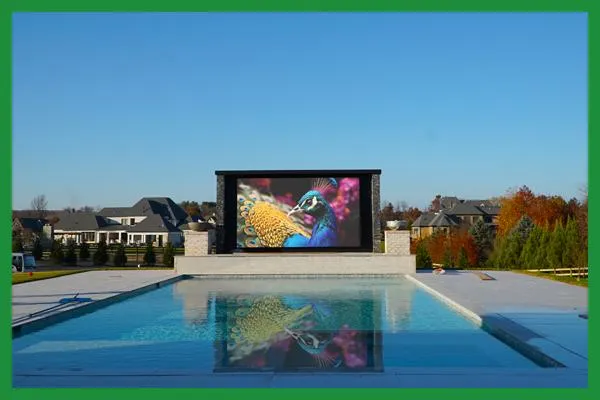
A full-sun outdoor display operating without shade structures beside a luxury pool in direct midday light.
What separates a true full-sun display from a consumer panel bolted to an outdoor mount is not marketing language, it is three engineering decisions working together. Get any one of them wrong and the screen either washes out by noon, overheats and shuts down by mid-afternoon, or fails in its first storm. Get all three right and the display runs from the first warm weekend in March through the last football Sunday in November.
What Defines a True Full Sun Outdoor TV?
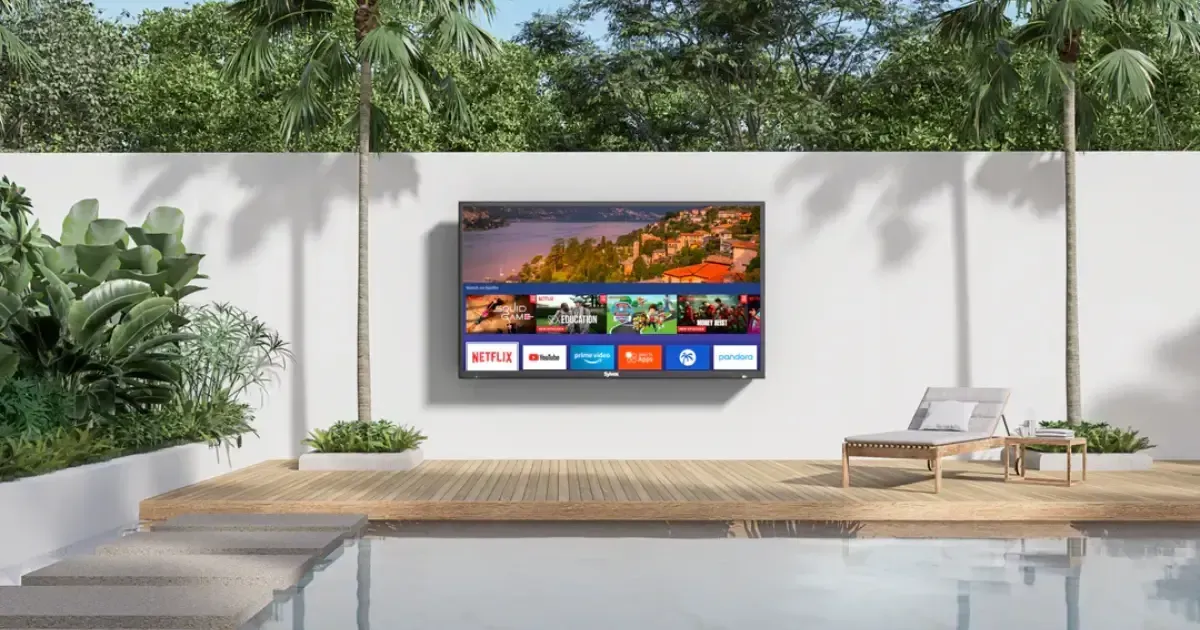
Many consumer displays advertised as "outdoor" are actually "partial sun" or "shade only" units that top out at 1,000–1,500 nits. When direct midday sun hits the panel face, the image becomes virtually invisible, the surface mirrors the sky instead of showing the game.
A genuine full-sun outdoor system requires three core engineering benchmarks:
- Over 6,000 Nits of Daylight Brightness: Enough luminous output to overcome direct noon solar glare and keep the image saturated.
- Anti-Reflective Micro-Louvers: Physical diode housing that diffuses ambient daylight rather than bouncing it like mirror glass.
- Advanced Thermal Backplanes: Active cooling and heat-sink dissipation that prevent black-screen thermal shutdown when baking in 100°F+ summer sun.
Without all three, a display may survive outdoors but it will not be watchable in full sun. Brightness alone is not enough if the glass reflects the sky; thermal management alone does not help if the panel is too dim. A true full-sun system is engineered as a complete package.
Why Brightness Is the Starting Point
Brightness, measured in nits, is the single most important spec for full-sun viewing. Midday sun delivers enormous ambient illuminance, far more than any indoor environment. To produce a vivid image against that light, the display has to push out enough luminous output to compete.
YOLO TV outdoor displays are engineered specifically for demanding outdoor environments. Our standard outdoor systems deliver approximately 6,000 nits of brightness, with configurations available from 4,000 to 7,000 nits based on the application. Recommended brightness depends on factors such as screen orientation, direct sun exposure, viewing time, pixel pitch, geographic location, and intended use.
A consumer "outdoor" TV typically delivers 700–1,500 nits, bright enough for a covered porch, not for an open pool deck. Below roughly 5,000 nits, ambient light overwhelms the emitted image and the surface turns reflective. At 6,000 nits standard, with configurations up to 7,000 nits for the most demanding orientations, the display stays vivid from the morning swim to the evening movie.
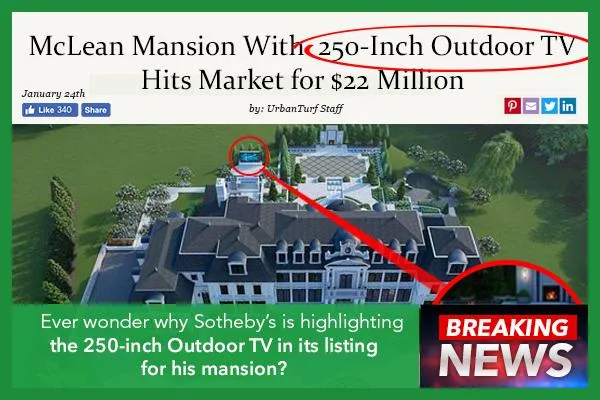
At 6,000 nits, the picture stays readable in direct sun without shade structures or hoods.
Orientation and Time of Day Matter
Not every full-sun installation faces the same challenge. The direction the screen faces changes the brightness you need as much as whether it is covered. A west-facing screen takes the full force of low afternoon and evening sun, often right during prime viewing time. An east-facing screen gets morning sun but is often in shade by afternoon.
Low-angle sun is especially tricky because it can slip under roofs and overhangs that block midday light. That is why a "covered" west-facing patio sometimes needs full-sun brightness. Before choosing a display, notice where the sun hits the mounting location at different times of day and across seasons.
If you mostly watch in the evening, a lower brightness range may serve you well. If you plan to watch afternoon football, daytime pool parties, or weekend golf, you need a screen built for the brightest hours your space sees.
Thermal Management: The Hidden Spec
Sun loading can push a screen's temperature up quickly. A display that is bright enough at noon can still fail if it cannot shed heat. Outdoor TVs need to be engineered to handle thermal load so the display stays stable and does not darken or shut down in hot conditions.
Active thermal backplanes and heat-sink dissipation are what prevent the black-screen shutdown that plagues consumer panels left in the sun. This is especially important in climates like Las Vegas, Phoenix, and Texas, where a panel can bake for hours at well over 100°F.

Active thermal management keeps a full-sun display running through peak afternoon heat without black-screen shutdown.
The thermal question is the one most often missed in the buying process. A brightness number on a spec sheet tells you the display can be seen at noon. It does not tell you whether the display can still be seen at 3 PM after four hours of direct sun loading. Ask for the thermal specification, how the display sheds heat, what its operating temperature range is, and what happens when ambient temperature exceeds it. A purpose-built full-sun system answers all three questions. A consumer panel in a box does not.
Weather Protection for Permanent Placement
A full-sun display is, by definition, permanently outdoors. That means it has to survive not just sun but rain, dust, humidity, and temperature swings.
Outdoor systems are available with IP65–IP68 ingress-protection ratings, depending on the specific display configuration and installation environment. Ingress-protection requirements can vary based on cabinet and module construction, system configuration, installation environment, and the level of weather protection required.
A certified IP65–IP68 enclosure means the display is fully dust-tight and sealed against water jets and driven rain. There is no cover to remove before each use and no cover to replace at night. The screen simply turns on and off, which is exactly what a full-sun installation demands.
Every YOLO TV residential display is backed by our industry-leading 5-Year Peace of Mind Parts Warranty. Covered YOLO TV components are protected for five years, and because our LED systems are modular, many parts can be replaced individually without replacing the entire display. On-site service, technician travel, shipping, and third-party labor may be separate unless specifically included in your agreement.
Sizing a Full-Sun Display to the Space
Brightness keeps the picture visible. Size makes it immersive. A full-sun display that is too small for the sightline forces guests to crowd near the screen, which defeats the purpose of an open backyard. Size to the furthest viewing distance, not the nearest.
| Diagonal | Comfortable Viewing Distance | Typical Full-Sun Setting |
|---|---|---|
| 115" | 12–16 ft | Covered patio edge, outdoor kitchen |
| 158" | 18–24 ft | Poolside seating, standard backyard |
| 202" | 24–30 ft | Open pool deck, multi-zone patio |
| 246"+ | 30+ ft | Estate lawn, commercial patio |
A 158-inch diagonal beside a pool reads as a feature, not an intrusion. For west-facing walls or larger decks where guests sit 30 feet or more from the screen, stepping up to a 202-inch or larger diagonal keeps every guest immersed without pixel visibility.
Planning the Install Before the Pour
A full-sun display is a permanent structure, not a seasonal accessory. The best time to plan it is before the hardscape and landscaping are finished. Power, data, structural mounting, and weather-sealed component housing are all far easier, and far less expensive, to install during construction than to retrofit later.
Key planning decisions include a dedicated electrical circuit sized for the display's draw, a weather-sealed and surge-protected data path, and a structural mount engineered for the display's weight and wind load. For Rise™ hidden systems, the subterranean vault and drainage must be coordinated with the pool and hardscape contractor during excavation. Getting these decisions right during the build means the display runs for a decade without a second thought.
📌 Key Takeaway: Midday sunlight requires a verified 6,000-nit luminous output, anti-glare engineering, and active thermal management. Anything less forces you to wait until dusk or build expensive overhead shade structures.
Frequently Asked Questions
Quick answers to the questions homeowners ask most.
For direct, full-sun exposure during midday hours, 5,000 nits is the floor and 6,000 nits is the safe standard. YOLO TV outdoor systems deliver approximately 6,000 nits standard, with configurations up to 7,000 nits for the most demanding orientations like west-facing walls.
No. Consumer outdoor TVs typically output 700 to 1,500 nits, which is not enough to overcome midday ambient light. A purpose-built high-brightness LED display is the only technology engineered to stay legible in direct sun without shade structures.
If your display delivers 5,000-plus nits, no shade structure is required. A properly bright display stays vivid from sunrise to sunset without overhead coverage. A shade structure becomes necessary only when the display is undersized for the sun exposure.
The screen turns reflective. Below roughly 5,000 nits, ambient light overwhelms the emitted image and the surface mirrors the sky rather than showing the game. The display may be technically working but effectively unwatchable.
Yes. West-facing screens take strong afternoon and evening sun, often during peak viewing hours, and may need a higher brightness range than their coverage alone suggests. Always match brightness to the actual sun exposure at the mounting location.
A purpose-built full-sun system is engineered as a complete package, brightness, anti-glare treatment, active thermal management, and certified weather sealing. That is what makes permanent outdoor placement realistic through summer heat, afternoon thunderstorms, and seasonal changes.
Written by Brian Bachman
YOLO TV designs and installs luxury outdoor TVs, hidden Rise™ TV systems, and custom outdoor entertainment solutions for homeowners, builders, architects, designers, and AV integrators. Our engineering team specializes in creating unforgettable outdoor viewing experiences.
Standard Specifications
- Target Brightness
- 6,000 Nits Direct Sunlight
- Sunlight Rating
- Full Sun Direct Exposure
- Weather Sealing
- IP65 – IP68 Ingress Protected
- Screen Sizes
- 115" up to 317"
Find the Right Display for Your Outdoor Space
Send YOLO TV a few pictures of your backyard, your installation address, and your approximate viewing distance. We'll help determine the size, brightness, and configuration that make sense for your space.
You May Also Like
More guides and case studies from the YOLO TV engineering team.

Why YOLO TVs Are the Ultimate Choice for Crisp, Clear Picture Quality: Understanding Viewing Distance and Resolution
Read article →The Secret to Elevating Your Home's Value: The Outdoor TV Phenomenon
Read article →